
You want to ask an AI tool to write a review for your book, author bio, or newsletter. Whilst the text is grammatically correct it might just be too generic. To make your AI text more natural you will need to do more than change some of the adjectives. Instead give your text a perspective, structure, and natural flow. Here are seven steps you can take to help your text look more natural – we will use a paragraph from a book review.
Why AI Text Can Be Unnatural
The problem isn’t that every AI sentence is bad. It’s that many of them sound quite generic. Whilst AI writing tools can be used to generate clean paragraphs quickly, there will often be a pattern. The sentences will be too consistent, too generic, and too flowery.
Take this example of a first draft of a review:
Original AI draft
“Pride and Prejudice is a timeless literary masterpiece that explores love, social class, and personal growth. Through memorable characters and engaging storytelling, Jane Austen offers valuable insights into human relationships.”
Nothing is obviously wrong with it. But what does the reviewer actually think about Austen’s novel? Which character, scene, or decision supports the praise? A paragraph full of compliments can still tell the reader very little.
Whilst there is a pattern here, humans often use common phrases too. Particularly if they are under pressure. The useful question is whether each sentence earns its place.
7 Steps to Make AI-Generated Text More Human
Before you begin to humanize AI writing, make sure you know what you want to say. Otherwise you may end up improving sentences that don’t fit. We will make the Austen paragraph more specific without inventing facts or personal experiences.
1. Improve Argument
Read through the text and summarize its point in one sentence. If you can’t, you’ll need to improve your argument.
Ask yourself what you want the reader to learn from your review. If you’re writing an author newsletter, are you letting them know about a new release, sharing an update or recommending a book? Make sure your text focuses around your purpose and remove any extra information.
Trying to change AI writing to human prose one adjective at a time will still leave your text looking like a template. We need to focus on the fact that this paragraph should be about Elizabeth Bennet confronting her mistaken judgment of Darcy, not on calling Pride and Prejudice a masterpiece.
2. Add Specific Detail
Look for any generic statements. These will often include words like ‘compelling’, ‘thought provoking’, and ‘memorable’. These don’t really tell the reader anything.
To rewrite AI text to sound human, anchor your claims in something recognizable: a character’s decision, a change in tone, or a pivotal scene. Darcy’s letter makes Elizabeth rethink both Darcy and Wickham. That detail does more than another sentence about “valuable insights.”
Don’t invent quotations or page numbers. Check any quotation against the edition you’re discussing.
3. Bring In Your Own Perspective
Details help, but readers also need to know what you think of them. Just keep it clear.
What shocked you? What did you misunderstand? What would you argue with someone about?
After content edits
At first, Elizabeth Bennet is convinced she understands Darcy. But after reading his letter, she has to reconsider what she thought she knew. That change in judgment deserves more attention than another general discussion of love and social class.
This paragraph has a clear message. Now we’ll make some improvements to the language.
4. Use an AI Text Humanizer
Let a tool handle the first pass on stiff phrasing and repeated patterns. In Step 5, you’ll refine the language yourself.
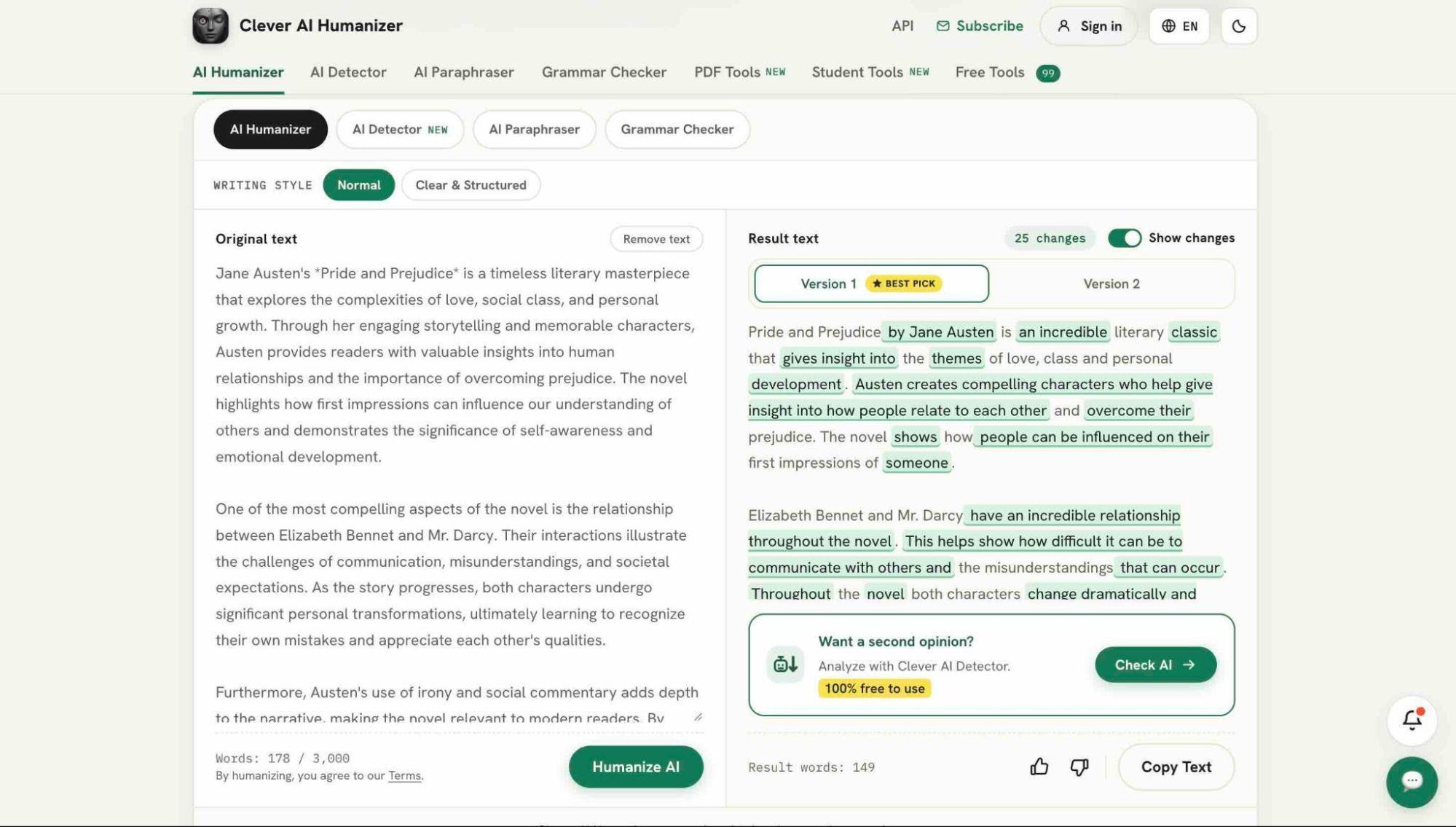
The best option is to use an AI to human text converter after you’ve decided on your argument and ensured the facts are correct. For example, you can use Clever AI Humanizer to change AI to human text once the draft says what you want it to say. Paste your text in and select the writing style that suits your audience. This service currently has options for casual and more structured writing. Keep any improvements but add back in any phrases that have lost their meaning. Don’t include any made up claims. A text humanizer won’t be able to add your opinion about the novel. Always check any rules about using AI and privacy before uploading your text.
5. Improve Flow and Remove Generic Phrases
Read through a few sentences. Are they all the same length? Are they starting with similar phrases? Try to vary sentence lengths by having short statements and longer explanations.
Some simple changes to make:
|
Instead of |
Try |
|
“It is important to note that…” |
State the point directly. |
|
“The novel delves into the complexities of…” |
Name the conflict or choice. |
|
“In conclusion, this timeless work…” |
End with your actual judgment. |
Use contractions when they fit. Favor active verbs. Don’t change a good sentence just to make it quirky.
After improving the language
Elizabeth Bennet thinks she has Darcy figured out. She doesn’t. Darcy’s letter forces her to question her first impressions, and that shift makes the novel interesting: Austen lets her heroine be both clever and wrong.
The reviewer now has a clear opinion.
6. Check the Facts
Double check your text against your sources. Make sure names, book titles, character relationships, plot points, dates, quotes, and links are all correct. When rewriting text, the roles of people can be changed and definite claims can be made from something that was more of an opinion.
For academic work, confirm every quotation and citation in the primary text or a reliable source. If a detail can’t be verified, remove it or explain the uncertainty. Don’t worry about making your sentences flow if they are incorrect.
7. Read the Finished Text Aloud
Read through your text at a normal pace. Ideally read it away from your screen. Are there any places where you run out of breath? Stumble over phrases? Or repeat the same opening?
A good way to check is to ask yourself if you would say this sentence to someone asking what you thought of the book. If not, rewrite it so you would say it. Ensure it still fits the tone of the publications.
Four Editing Mistakes That Make AI Text Worse

Efforts to humanize AI content sometimes go in the wrong direction. You can spot the problem when a rewrite sounds busier but says less.
- Adding deliberate typos. Misspellings don’t create a personal voice; they make an otherwise useful article harder to trust.
- Forcing slang into formal writing. A book review for a literary magazine shouldn’t suddenly sound like a group chat. Match the reader and publication.
- Deleting every em dash. Punctuation isn’t a reliable test of authorship. Keep a dash when it makes the sentence clearer, and remove it when another mark works better.
- Replacing words just to be different. A synonym tool can turn precise terms into awkward or inaccurate ones. In literary criticism, narrator, protagonist, and author aren’t interchangeable.
The aim is to make intentional changes to help your argument. Readers will notice if your text is clear and has content. They won’t notice the “natural” punctuation.
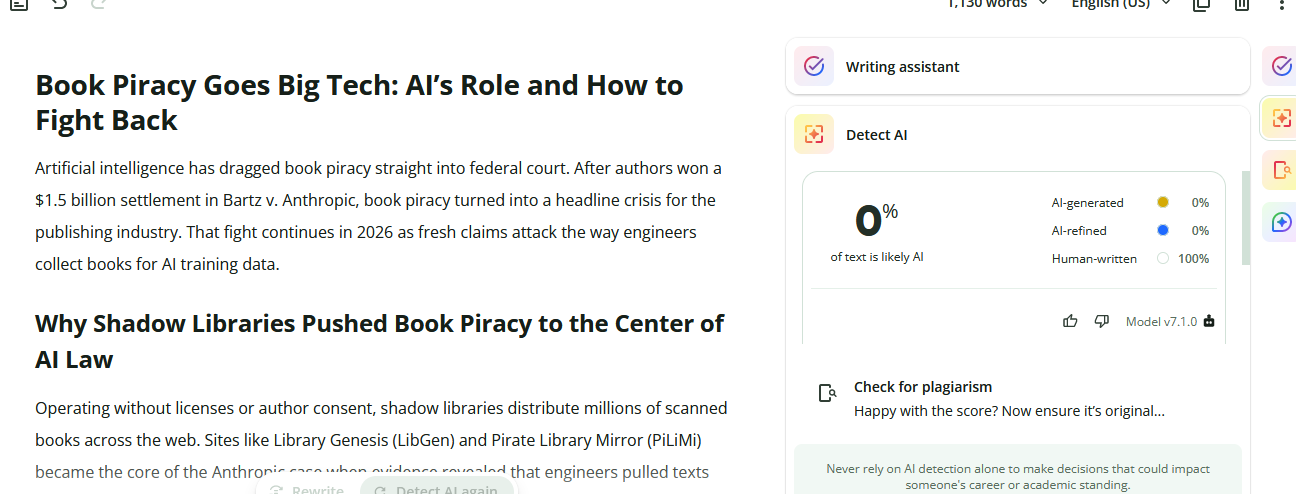
Once the draft reads well, you can run a final check. An online AI writing checker can highlight sentences with patterns that resemble generated writing. Review those passages in context, and change them only when the edit improves the text. An AI writing detector won’t be able to tell you who wrote the paragraph.
Common Questions
Can You Ask ChatGPT to Make Its Own Writing Sound Human?
Yes, but a vague prompt like “make this sound more human” often produces another generic rewrite. Give it a narrower instruction: “Make these sentences more direct, preserve the facts, cut repeated transitions, and don’t invent any personal experiences.” You still need to judge the result yourself.
Can You Make AI Text Sound Human Without Paid Tools?
Yes. You can revise the argument, replace vague claims with evidence, trim unnecessary words, and read aloud without buying software. Free editing tools may help with grammar or phrasing, but the most important changes come from your choices as a writer.
Will Humanizing AI Text Change Its Original Meaning?
It can. Automated rewrites may alter tone, remove a qualification, or accidentally change a factual relationship. Compare the new draft with your sources and restore anything important that got lost.
Do You Need to Disclose AI Assistance?
It depends on the assignment, publisher, employer, or platform. Some allow brainstorming and editing assistance but restrict AI-generated submissions. Follow the rules that apply to your work, and don’t use rewriting as a way to misrepresent authorship.
The Last Pass
Ensure you have a clear argument, add facts to back this up, and clearly state your opinion. Then improve the language, ensure all facts are correct, and read it aloud. Whilst some tools will help with the middle part, your decisions as a writer will make the difference between a good review/essay/newsletter.