


History becomes easier to understand when we can see not only what happened, but also how people lived, what they created, and why they fought. Books are especially good at bringing these parts together. They give us enough space to follow an idea from its beginning, understand the people behind it, and see how one discovery or conflict influenced what came next.
How inventions changed everyday life
Some of the biggest changes in history started with practical problems. People needed better ways to grow food, move heavy objects, travel long distances, communicate, build cities, treat disease, or produce goods. The solutions they developed eventually changed everyday life far beyond the original problem.
For readers interested in the discoveries and technologies that shaped civilization, this book about inventions offers a way to explore that history through the objects, mechanisms, and people behind major technological changes.
This kind of approach makes history more concrete. The Industrial Revolution, for example, becomes easier to understand when we look closely at the steam engine, factory machinery, rail transport, and new manufacturing methods. We can see why cities grew, why work changed, and why goods began moving farther and faster.
The same is true for much older inventions. The wheel, writing, irrigation, metalworking, and early navigation were not isolated discoveries. Each one affected what people could build, trade, record, or pass on to the next generation.
Books give these developments room to connect. Instead of jumping from one famous invention to another, readers can follow how knowledge builds over time.
The people behind technological change
It is easy to talk about inventions as if they simply appeared when humanity needed them. In reality, progress is rarely that simple.
Some inventions came from one recognizable figure. Others developed slowly as different people improved an existing idea. Many discoveries happened because knowledge from different cultures and periods came together.
Books can show this process better than a short timeline or list of dates. They can explain what was already known, what problem someone was trying to solve, and what had to happen before a new idea became practical.
That context also makes famous inventors more interesting. Leonardo da Vinci is remembered for ideas that were centuries ahead of their time, but many of his concepts could not actually be built with the materials and technology available to him. Nikola Tesla’s work makes more sense when placed inside the rapid development of electricity in the late 19th century. The development of aviation becomes much richer when we see the long series of experiments that came before powered flight.
Looking at the process helps remove the idea that history was created by a few people having sudden moments of inspiration. Most progress involved testing, failure, improvement, and ideas borrowed from earlier work.
Why illustrations make history easier to understand
This is one reason illustrated history books remain useful even when so much historical information is available online.
Some subjects are simply easier to understand visually. A description of an early printing press can tell us what it did, but a detailed drawing can show the arrangement of the press, type, paper, and moving parts at the same time. A cross-section of a machine can explain relationships between components that would require several paragraphs to describe.
Illustrations are also helpful when the original object no longer exists or has changed greatly over time. Reconstructions can show how ancient engineering, early ships, fortifications, tools, or scientific devices may have worked.
The best historical illustrations do not replace the written explanation. They work with it. The text gives context, while the image helps the reader see the object, process, or event more clearly.
Understanding conflict as part of history
Inventions tell only one side of human progress. Many of the same technologies that improved transport, communication, engineering, and manufacturing also changed warfare.
The relationship works in both directions. Military needs have often pushed societies to improve materials, medicine, transportation, navigation, communication, and engineering. Some technologies later found major civilian uses, while civilian inventions also changed what became possible on the battlefield.
Readers who want to explore the evolution of warfare, weapons, and military strategy can also turn to a military history book to see how armies, equipment, tactics, and technology changed alongside the societies that created them.
Studying military history this way is more useful than simply memorizing famous battles. Weapons matter, but so do logistics, communication, geography, leadership, training, and the ability to adapt when an opponent changes tactics.
Why warfare changed so much over time
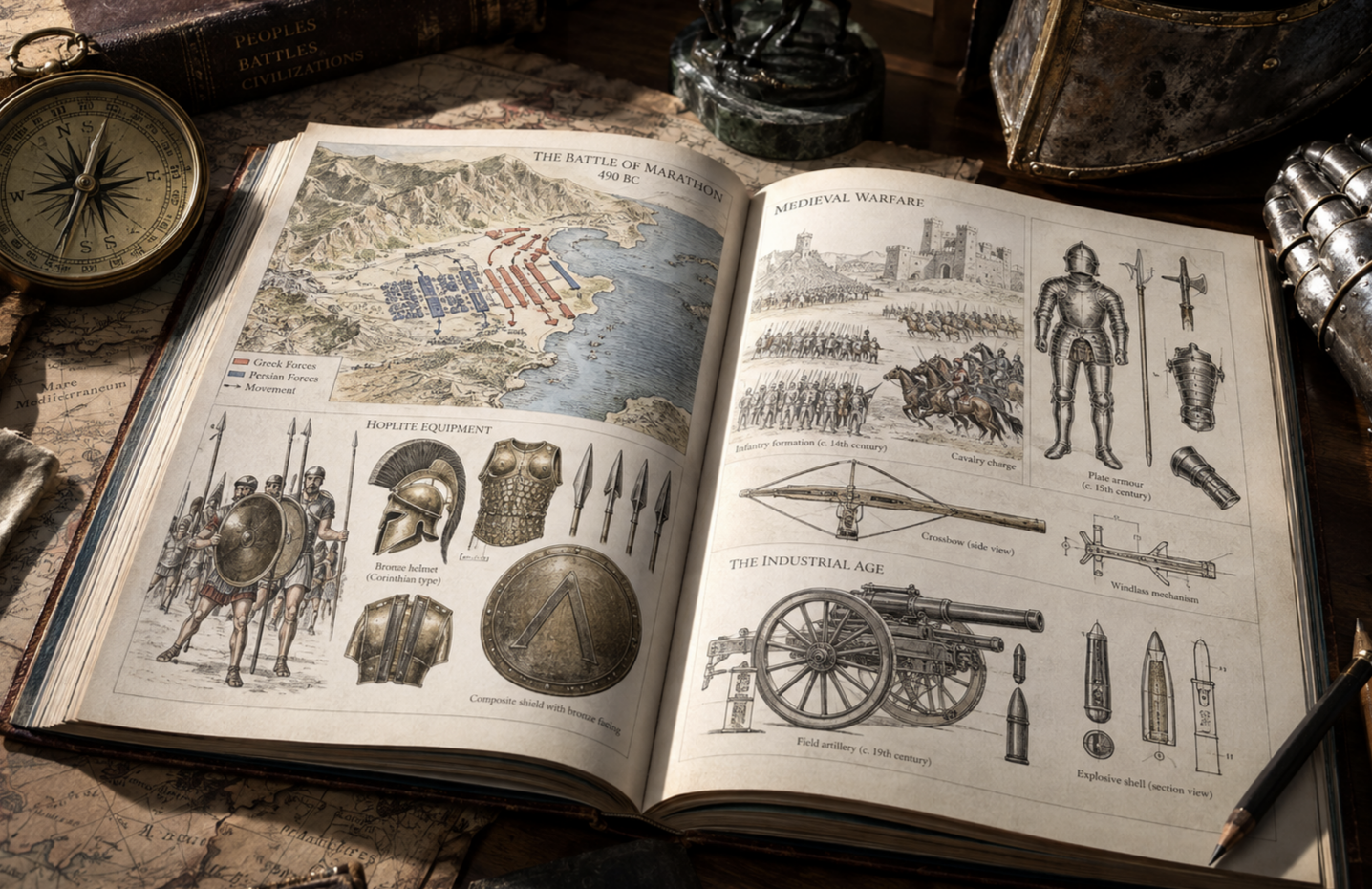
An army from the Roman period and an army from the 20th century may seem to have very little in common, but both depended on the same basic problems: how to move people, supply them, communicate orders, defend positions, and use available technology effectively.
What changed were the solutions.
Metallurgy improved armor and weapons. Gunpowder changed fortifications and battlefield tactics. Industrial manufacturing made it possible to equip armies on a much larger scale. Railways changed military transport, while radio transformed communication. Aircraft added another dimension to warfare, and later developments brought radar, guided weapons, drones, satellites, and digital systems.
Looking at those changes in order helps explain why military strategy had to change with them. A new weapon rarely matters on its own. Its real impact depends on how people learn to use it.
That is also why maps, diagrams, timelines, and illustrations are so valuable in books about warfare. Seeing a formation or defensive structure is often much clearer than reading a long description of where every unit stood.
Inventions and conflicts are closely connected
Studying invention and military history together also reveals how closely the two subjects overlap.
Navigation helped explorers cross oceans, but it also helped naval powers expand their reach. Advances in medicine saved civilian lives while changing survival rates for wounded soldiers. Aviation transformed travel and trade while creating entirely new forms of warfare. Computers began as specialized machines and eventually changed everything from business to military planning.
Even technologies we think of as completely modern have older connections. The internet grew partly from research into resilient communication networks. Satellite systems now help people navigate to a restaurant while also supporting military communication and intelligence.
This does not mean that technological progress is driven only by conflict. Far from it. It shows that inventions develop inside real societies, and societies have always had both peaceful and military needs.
Understanding those connections gives us a more complete view of history.
Books help us see the connections
A single historical fact is easy to find. Search for the year an invention appeared or the date of a battle, and an answer arrives almost immediately.
Understanding why it mattered takes longer.
Books give readers the space to follow those connections without reducing history to isolated facts. A new invention can be placed beside the older ideas that made it possible. A weapon can be explained together with the strategy it changed. A famous person can be understood as part of a wider period rather than as a name beside a date.
This is especially valuable when text is combined with strong visual material. Detailed illustrations, diagrams, maps, and timelines make complex subjects easier to explore without turning them into simplified summaries.
History is not only a record of what people did. It is also a record of what they knew, what they built, what problems they faced, and how they responded to them.
Books help keep all of those parts together. And that is often where history becomes much more interesting.