
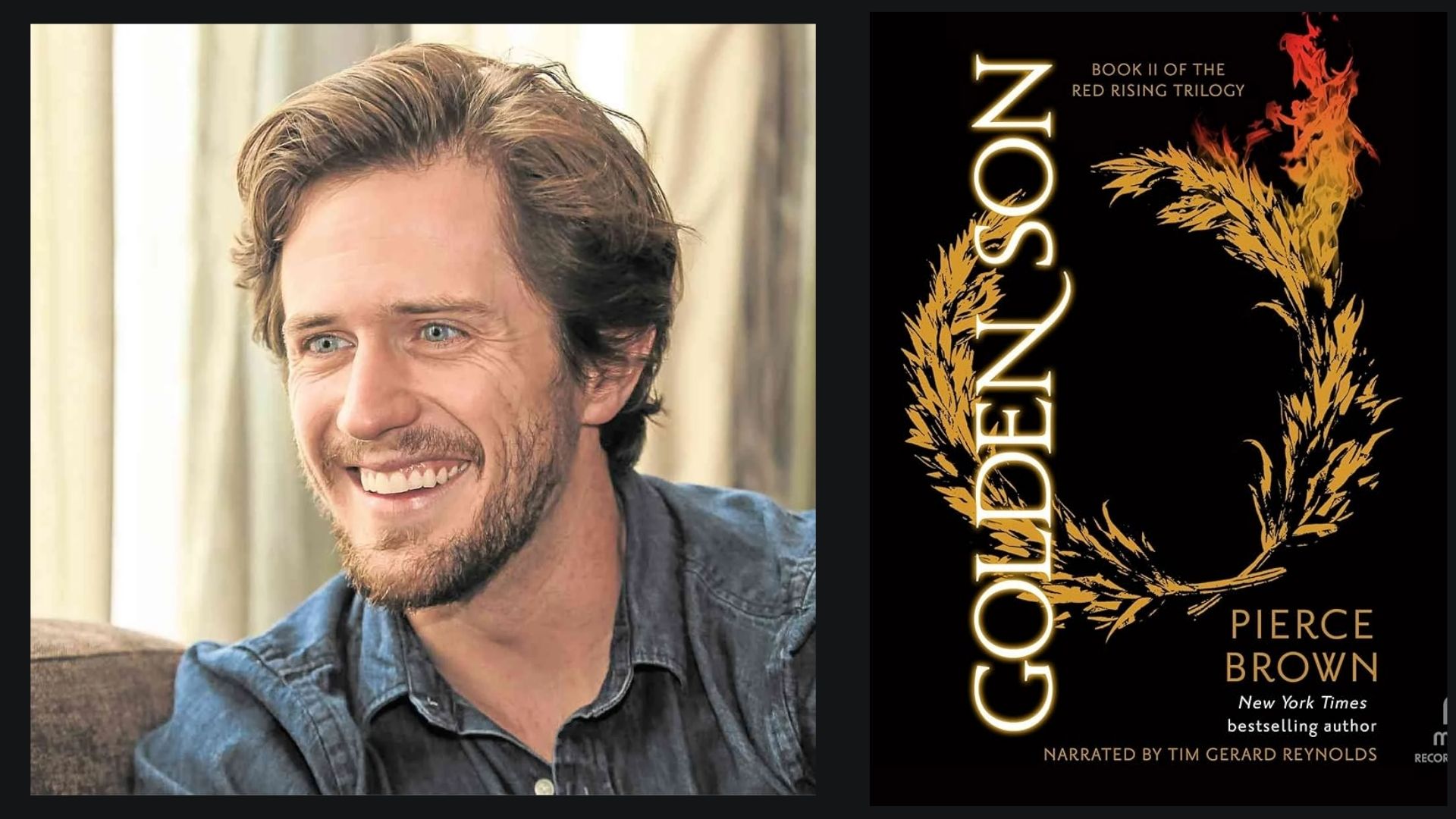
I read Golden Son in two sittings. I couldn’t put it down.
This is the second book in Pierce Brown’s Red Rising series, and it hits harder than the first. I’ve read the full series more than once, so you’re getting real insight here, not filler.
In this article, I’ll cover the full story recap, key characters, major themes, writing strengths, reader reception, and a bit about the author.
If you want to know what happens, what it means, and whether it’s worth reading, you’re in the right place.
Golden Son Summary (Full Story Recap)

Golden Son picks up right after the first book. Darrow is serving under Nero au Augustus, trying to prove himself as a true Gold. He fails a key military exercise, and his cover is suddenly at risk.
A duel with Cassius au Bellona splits the Gold families apart and drags Darrow into a power struggle he didn’t see coming. New allies step in. Sevro brings the Howlers, and Ragnar Volarus joins the fight.
Darrow then leads the Iron Rain, a massive assault on Mars. It’s brutal and costly.
The ending hits hardest. Roque au Fabii, one of his closest friends, betrays him. Darrow is captured, his army collapses, and everything falls apart. The book ends at his lowest point, leading straight into Morning Star.
Key Characters Analysis
The characters are what make this series work. Brown writes people, not just roles. Here’s a breakdown of the key players in Golden Son.
Darrow (The Reaper)
Darrow grows a lot in this book, but not always in clean or comfortable ways.
He becomes a better leader. His tactical thinking is sharper, his decisions bolder. But he also makes mistakes that cost people their lives, and he carries that weight.
The moral conflict is constant. He’s lying to almost everyone around him. He’s using people he cares about. And he’s starting to wonder whether the revolution he’s fighting for is worth what it’s costing him personally.
Virginia “Mustang” au Augustus
Mustang is one of the smartest characters in the series, and Golden Son makes that very clear.
Her relationship with Darrow becomes more complicated here. She’s not just a love interest. She makes her own choices, forms her own plans, and pushes back on Darrow when she disagrees with him.
Her emotional depth is real. She’s not perfect, but she’s principled. And she plays a bigger role in shaping the direction of events than most people around her realize.
Adrius “The Jackal” au Augustus
The Jackal is terrifying because he’s so calm about it.
He’s Mustang’s twin brother and one of the most dangerous minds in the Gold world. You’re never quite sure what he’s planning, and that unpredictability makes every scene with him feel tense.
He plays multiple sides at once and does it with a smile. He’s not a villain you love to hate. He’s a villain you genuinely fear.
Sevro au Barca
Sevro is raw, loyal, and completely unpredictable.
Where Darrow sometimes overthinks, Sevro acts. He’s fierce, a little unhinged, and completely committed to Darrow’s cause. He’s also funny in the darkest possible way.
In Golden Son, Sevro steps into a bigger role and carries it well. His loyalty is one of the few things in this book that feels completely uncomplicated.
Roque au Fabii
Roque starts the book as a trusted friend and ends it as something else entirely.
His shift is tragic because it’s not random. There’s logic behind it. You can see the moment things change for him, even if it still hurts when it happens.
He represents the cost of war on personal relationships. Not everyone can follow Darrow where he’s going, and Roque’s arc shows why in the most painful way possible.
Major Themes in Golden Son
Golden Son is a war story, but it’s really a book about what war does to people and systems. Here are the core themes running through it.
Class Struggle and Social Inequality
The Color system is the backbone of this series.
Reds are at the bottom. Golds are at the top. Everyone in between exists to serve that structure.
Golden Son keeps that tension alive by putting Darrow inside the Gold world and showing how deeply the inequality is built into everything, the language, the rituals, the way people treat each other.
It’s not subtle, and it’s not meant to be.
Loyalty vs Betrayal
Almost every relationship in this book gets tested.
Some people hold. Some break. Roque’s betrayal is the most obvious example, but there are smaller moments throughout the book where loyalty gets weighed against self-interest or survival.
Brown doesn’t frame betrayal as simple villainy. He shows how people get there, which makes it hurt more.
Power, Politics, and Manipulation
The Gold families don’t just fight with weapons. They fight with information, alliances, and leverage.
Golden Son is full of political maneuvering. Characters say one thing and mean another. Deals get made and broken. Nobody shows their full hand.
It’s exhausting in the best way, and it makes Darrow’s position feel genuinely precarious at every turn.
Identity and Deception
Darrow is always performing.
He has to act like a Gold while thinking like a Red. He has to build real friendships while knowing he’s hiding a truth that would destroy everything. That constant performance takes a toll, and the book is honest about it.
His identity crisis isn’t dramatic or sudden. It’s a slow, quiet pressure that builds across the whole story.
The Cost of Revolution
This is the theme that hits hardest.
Darrow wins battles. But people die. Plans fail. Friends are lost. And the Society he’s fighting against doesn’t just sit still while he attacks it.
Golden Son makes it clear that revolution isn’t clean or fast. It’s brutal, expensive, and deeply personal.
Writing Style and Narrative Strengths
Pierce Brown writes like someone who really loves action but also cares about the people in it.
The pacing in Golden Son is fast. Very fast. There are moments where the chapters fly by because you genuinely cannot stop. But Brown also knows when to slow down. The quieter scenes, the conversations between Darrow and Mustang, or Darrow and Sevro, give the story room to breathe.
The world-building expands significantly here. We move beyond Mars into a larger picture of the Society, and Brown handles that without losing focus on the characters.
The emotional beats land because the action has weight behind it. You care who lives and who dies. That’s not a given in a book this packed with plot.
What Works Well in Golden Son
Character development: Every major character grows or changes in a meaningful way. Nobody feels static.
Plot twists: The betrayals and surprises in this book are genuinely earned. They’re not random shocks. They grow out of the story.
Scale: Golden Son is bigger than Red Rising in every way, and it handles that size well. The jump from school battles to interplanetary war feels natural, not forced.
Reader Reception and Ratings
Golden Son holds a 4.7 out of 5 on Goodreads, which says a lot for a middle book.
Fans call it the point where they got fully hooked on the series. Critics praise Brown’s ability to mix action with political tension. The ending is widely called one of the most shocking in recent memory.
Middle books usually slow things down. This one does the opposite.
About the Author: Pierce Brown

Pierce Brown was born in 1988 and published Red Rising in 2014. Golden Son cemented his reputation as a serious voice in science fiction.
He’s said the series was inspired by class inequality and Roman history. You can feel that in every page.
Brown puts character first. The world is big, but it’s always grounded in people you care about. The Red Rising series now spans six books, with more on the way.
Conclusion
If you’ve made it this far, you already know Golden Son is worth your time.
It’s bigger, bolder, and more emotionally punishing than the first book. The ending will stay with you. Roque’s betrayal, Darrow’s capture, the complete collapse of everything he built — it’s a lot to sit with.
Personally, this is the book that made me fully invested in the series. I didn’t expect to feel that much.
If you’ve read it, drop a comment and tell me how you felt about that ending. And if you haven’t started the series yet, this is your sign to go find Red Rising.
Frequently Asked Questions
What is Golden Son about?
Golden Son is the second book in Pierce Brown’s Red Rising series. It follows Darrow as he rises through Gold society while secretly working to bring it down from the inside.
Do I need to read Red Rising before Golden Son?
Yes, you do. Golden Son picks up directly after the first book. Reading it out of order will spoil major plot points and make the character relationships harder to follow.
Is Golden Son better than Red Rising?
Many fans think so. It’s larger in scale, more politically complex, and has a much more shocking ending. It builds on everything Red Rising set up and pushes it further.
Who betrays Darrow in Golden Son?
Roque au Fabii, one of Darrow’s closest friends, is the one who betrays him near the end of the book. It’s one of the most talked-about moments in the entire series.
How does Golden Son end?
The book ends with Darrow captured, his army scattered, and most of his allies either dead or gone. It sets up Morning Star directly and leaves readers on one of the most intense cliffhangers in the trilogy.