

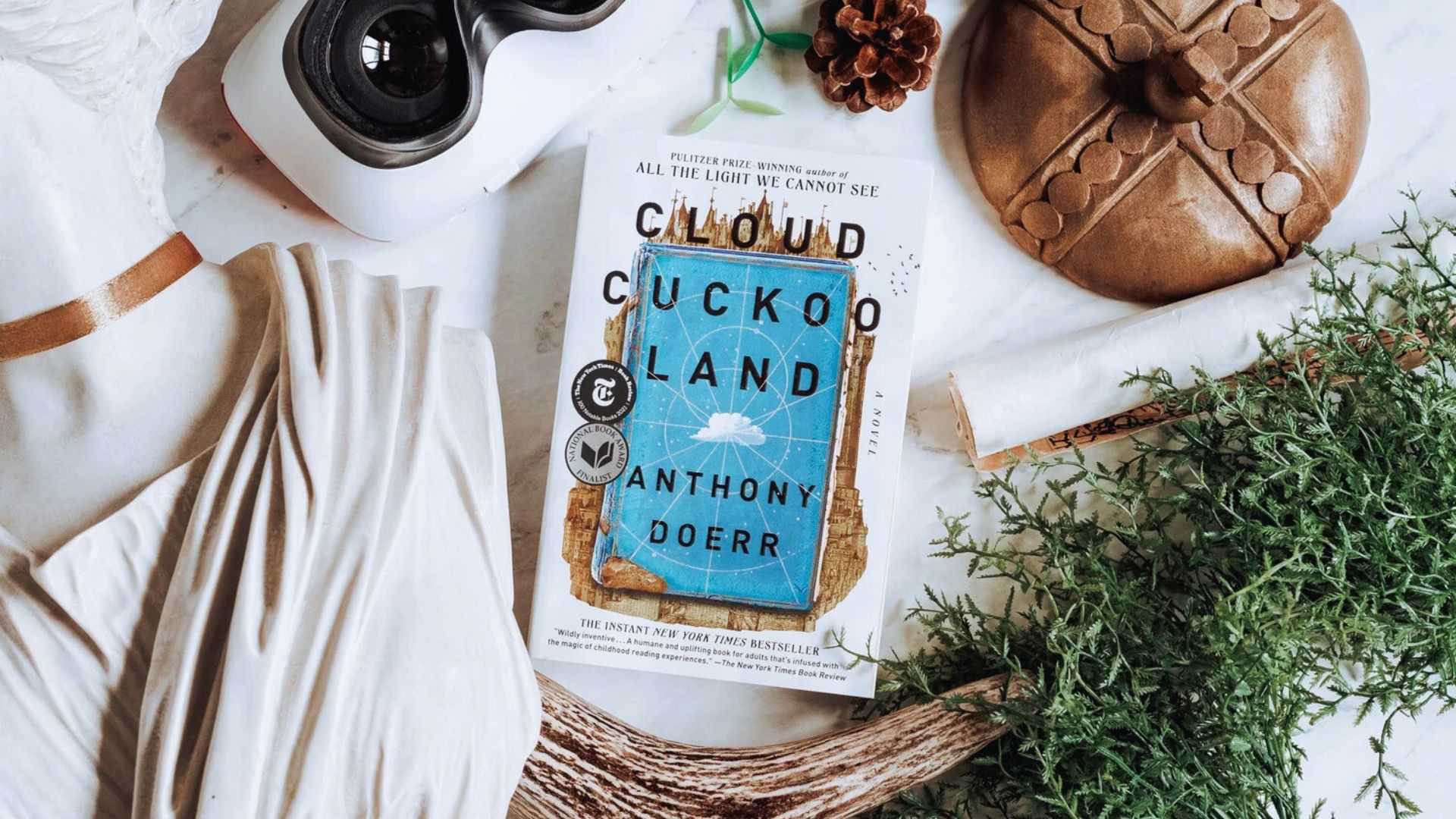
Looking for an honest Cloud Cuckoo Land book review? You are in the right place. Anthony Doerr’s follow-up to the Pulitzer Prize-winning All the Light We Cannot See asks a great deal from its reader and gives back even more.
Large in scope and serious in its belief that stories are among the most powerful things human beings have ever made, it rewards patience.
I read it over a week, setting it down not to stop but to absorb. This review covers the plot, themes, characters, and my personal response.
Synopsis of Cloud Cuckoo Land
The novel follows five characters across three timelines separated by centuries.
In fifteenth-century Constantinople, a young seamstress named Anna watches Ottoman forces close in on her crumbling city. Outside the walls, a gentle boy named Omeir is pulled toward the same conflict.
In present-day Idaho, elderly veteran Zeno translates a fragmented ancient Greek manuscript while a troubled young man named Seymour plants a bomb in the library where Zeno rehearses a children’s play.
In the far future, a girl named Konstance pieces together that same text aboard a spacecraft. One ancient fable connects them all.
Themes Discussed in Cloud Cuckoo Land
A sweeping meditation on the persistence of stories, the fragility of the natural world, and what it means to carry something precious across time.
Stories That Survive
The novel’s most insistent argument is that stories persist through fires, sieges, technological collapse, and the deaths of their readers.
The fictional manuscript at the novel’s center is copied by hand, hidden in walls, half-destroyed, and eventually transmitted into a future no one could have imagined.
Doerr treats this not as a comforting metaphor but as a serious claim about how culture and meaning carry forward across time.
Loss and the Natural World
Seymour’s storyline gives the novel much of its contemporary urgency, following a young man who grows up watching a landscape destroyed in real time.
His grief over the forest razed near his home and the owl he loved is recognizable, and his radicalization is rendered with a care that refuses to make him simply a villain.
The novel does not offer easy resolution on environmental destruction, but it takes the wound seriously throughout.
Connection Across Time
What Doerr builds across five timelines is a quiet argument about how the past and future press constantly on the present.
Anna in Constantinople has no way of knowing that the story she read as a girl will be rehearsed in a children’s production in Idaho more than five hundred years later.
The connections between characters are invisible to them and fully visible to the reader, and that gap is where the novel’s emotional power lives.
Character Analysis
Through warriors, dreamers, scholars, and survivors, the novel asks how ordinary people carry extraordinary things forward through time.
Anna
Anna is the novel’s most immediately compelling character. Stubborn and curious, she lives inside a dying city but keeps returning to the fragments of a childhood story.
Her sections make the fall of Constantinople feel close rather than like distant history.
Omeir
Omeir is one of the quieter miracles of the book. Born with a cleft lip and treated as a bad omen, he finds his purpose caring for oxen hauling siege weapons.
His chapters are not loud but carry a moral weight that stays with you.
Zeno
Zeno spent much of his life unable to tell anyone who he truly was. His translation work, carried out quietly in a small-town library, is an act of devotion that outlasts him.
His scenes with the children he directs are warm and quietly devastating.
Seymour
Seymour is a difficult character to spend time with, broken in a way that makes him capable of terrible things without ever being simply cruel.
Doerr roots his radicalization in grief rather than malice, producing a portrait more honest than condemnation alone could achieve.
Konstance
Konstance lives entirely inside a digital archive aboard a spacecraft, piecing together fragments of a text she has never seen in physical form.
Her timeline takes the longest to connect to the others, but when it does, it reframes everything you have already read.
Writing Style and Narrative Voice
With precise, luminous prose and an architecture of timelines that rewards patience, the novel builds its meaning slowly and releases it all at once.
Doerr’s Prose
The prose in Cloud Cuckoo Land is extraordinarily controlled, written with a clarity that accommodates both the grime of medieval siege warfare and the interior silence of a spacecraft.
Doerr does not call attention to his own sentences, but they accumulate with a precision that becomes quietly overwhelming by the final pages.
Moving between five timelines and three centuries could easily collapse into chaos, but the structure holds its weight from beginning to end.
World-Building
The world-building here is specific rather than spectacular, grounded in details that make each setting feel genuinely inhabited rather than constructed.
Constantinople in its final days feels lived in, the Idaho library is ordinary in exactly the ways a real library would be, and the spacecraft carries grief rather than glamour.
These details accumulate across hundreds of pages into something that becomes genuinely and unexpectedly affecting.
Critical Reception
Cloud Cuckoo Land was published in September 2021 and quickly became one of the most talked-about literary novels of that year.
It was a finalist for the Pulitzer Prize for Fiction and won the Carnegie Medal for Excellence in Fiction in 2022, cementing Doerr’s place among the most celebrated American writers working today.
The novel appeared on numerous year-end best-of lists across major publications including The New York Times, The Washington Post, and Time magazine.
Readers and critics alike responded to its ambition, its emotional range, and its deeply serious treatment of storytelling as a force in human life.
Notable Reviews and Ratings
Goodreads: 4.25 out of 5 stars based on over 200,000 ratings
Amazon: 4.4 out of 5 stars across tens of thousands of reviews
Awards: Carnegie Medal for Excellence in Fiction winner; Pulitzer Prize for Fiction finalist
My Personal Reading Experience
Cloud Cuckoo Land was not the book I expected, and I say that with genuine admiration. I had anticipated something ambitious but somewhat cold, more interested in structural cleverness than emotional truth.
What I found instead was a book that cared deeply about every character, including the ones who make choices you cannot excuse.
Zeno affected me most. There is something in the way Doerr writes his late-life translation project, this quiet act of love in a small-town library, that makes the novel’s central argument feel entirely real.
Stories survive because people like Zeno decide they are worth saving.
About the Author Anthony Doerr

Anthony Doerr is an American author based in Boise, Idaho, best known for the Pulitzer Prize-winning All the Light We Cannot See, published in 2014.
He is also the author of two short story collections and an earlier novel, About Grace, all of which established him as a writer of considerable precision and emotional intelligence.
Cloud Cuckoo Land represents a significant expansion of his formal ambitions, stretching across five characters, three timelines, and several centuries of human history.
It places him firmly in the company of writers who use multi-timeline structure not as a gimmick but as a genuine mode of serious literary inquiry.
Conclusion
I hope this Cloud Cuckoo Land book review gave you what you were looking for. This is a novel that operates at real scale, ambitious in form, serious in its questions, and genuinely moving in its answers.
It asks you to be patient with five separate characters across three different centuries, and if you offer it that patience, it repays you in full.
If you are looking for something that takes the written word seriously as a force in human life, this one belongs on your shelf.
Frequently Asked Questions
Is Cloud Cuckoo Land based on a true story?
No, it is fiction. The ancient manuscript at its center is invented, though Doerr drew on real Greek texts and historical events, including the fall of Constantinople in 1453, to ground the story.
How long does it take to read Cloud Cuckoo Land?
The novel is approximately 620 pages. Most readers complete it in ten to fifteen hours across several sittings.
What age is appropriate for reading Cloud Cuckoo Land?
The book suits adult and older teenage readers aged 16 and up. It contains some violence and emotionally difficult themes but handles them with care throughout.
Did Cloud Cuckoo Land win any literary awards?
Yes. It won the Carnegie Medal for Excellence in Fiction in 2022 and was a finalist for the Pulitzer Prize for Fiction.
Is there a film or television adaptation of Cloud Cuckoo Land?
As of early 2026, no major film or television adaptation has been released, though the novel’s rich visual scope and multi-timeline structure would lend themselves naturally to a long-form screen treatment.