


Educational certificate attestation is the official process of getting your academic documents verified by government authorities so they are legally accepted in another country.
If you are planning to work, study, or move abroad, this step can make or break your application. Many applicants lose job offers or visa approvals simply because their credentials were never properly verified.
In this guide, you will find everything covered clearly: what attestation means, how the U.S.-based process works step by step, what it costs in USD, how long it takes, country-specific rules, and how it compares to apostille.
This guide reflects 2026 standards and is built for U.S.-based applicants who want accurate answers without the confusion.
What Is Educational Certificate Attestation? (Simple Explanation)
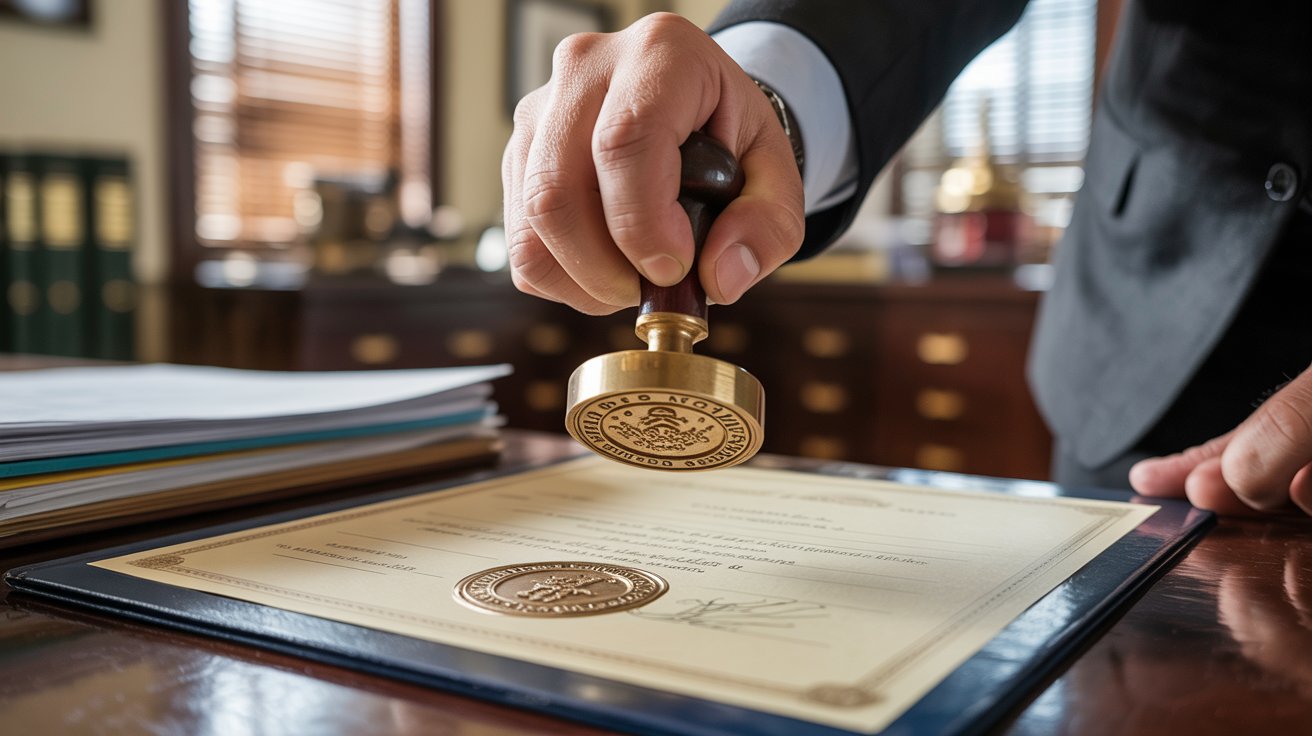
Educational certificate attestation is the process of having your academic documents officially confirmed by government bodies. It proves that your degree, diploma, or certificate is real and comes from a recognized institution.
Foreign governments, employers, and universities need this proof before accepting your credentials. Without it, your documents hold no legal weight outside your home country.
In the U.S., the process typically moves through a notary, then the Secretary of State, then the U.S. Department of State, and finally the embassy of the destination country.
Why Educational Certificate Attestation Is Important

Attested documents protect you at every stage of an international move.
For applicants, they confirm qualifications are genuine. This matters for work visas, professional licensing, and university enrollment abroad.
For employers and foreign governments, they need proof the issuing institution is legitimate and the document is unaltered.
Countries like the UAE, Qatar, and Saudi Arabia will not process a work permit or visa without attested academic documents.
Credential evaluation bodies like WES (World Education Services) also recommend verified documents for smoother processing.
Do You Need Educational Certificate Attestation for the USA?
This is one of the most searched questions on this topic. Here is the clear answer.
If you are moving to the USA, you generally do not need attestation. USCIS does not require attested academic documents as part of standard immigration filings. Employers in the U.S. use credential evaluation services like WES or ECE instead.
However, if you are a U.S.-based applicant moving from the U.S. to another country, full attestation is required. Countries like the UAE, Saudi Arabia, and Qatar demand authenticated U.S.-issued degrees before approving work visas.
So the rule is simple: attestation is needed when you are taking your documents out of the U.S., not when bringing foreign documents in.
When Apostille Is Enough (U.S. Scenarios)
Not every international move requires full attestation. For countries that are members of the Hague Apostille Convention, a state-level apostille stamp is all you need.
| Destination Country | Hague Member | Process Required |
| United Kingdom | Yes | Apostille only |
| Germany | Yes | Apostille only |
| Australia | Yes | Apostille only |
| Canada (from Jan 2024) | Yes | Apostille only |
| UAE | No | Full attestation |
| Saudi Arabia | No | Full attestation |
| Qatar | No | Full attestation |
| China | No | Full attestation |
If your destination is on the Hague list, go directly to the Secretary of State for an apostille and skip the embassy chain entirely. This saves weeks and significant cost.
Types of Educational Certificates That Require Attestation
Most academic records used internationally need attestation.
Common ones include:
- Degree certificates (Bachelor’s, Master’s, Doctorate)
- Diplomas and vocational training certificates
- Academic transcripts and mark sheets
- School completion or leaving certificates
- Professional certificates (nursing, engineering, teaching)
The exact documents required depend on the destination country and your reason for going.
Educational Certificate Attestation Process (Step-by-Step Guide)
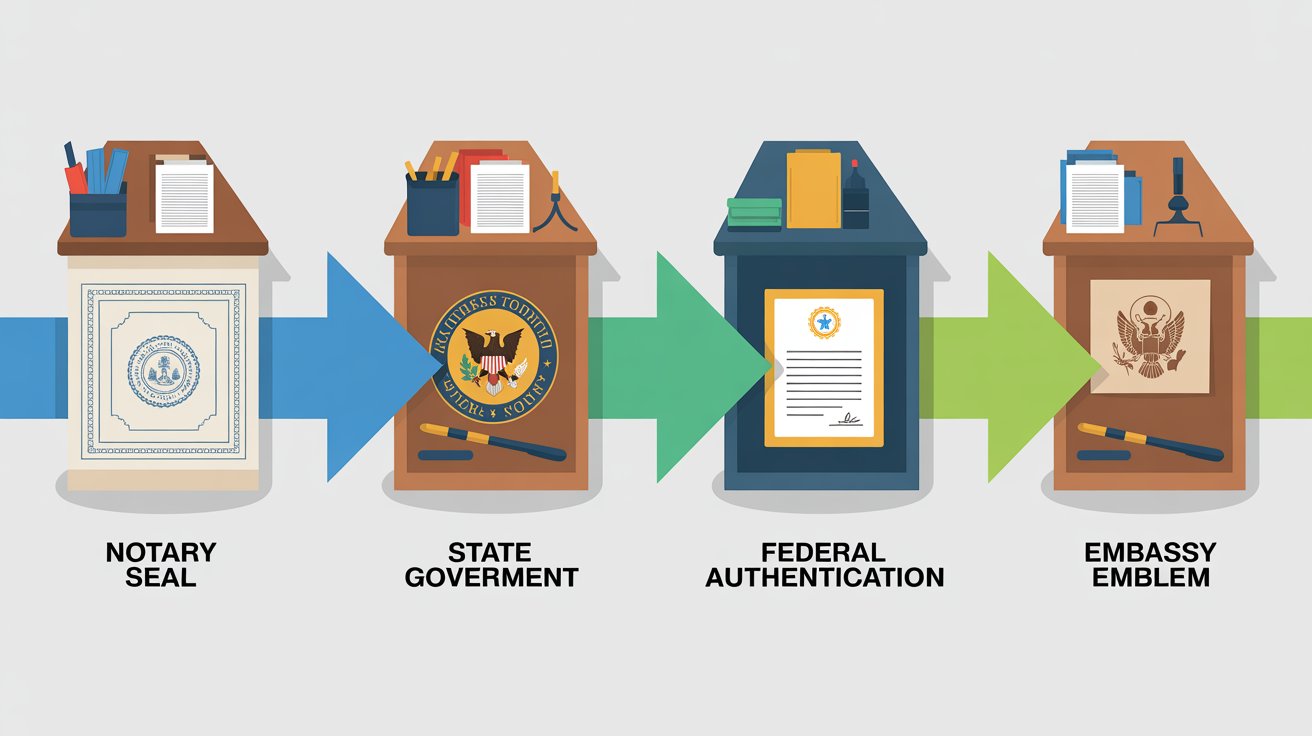
The U.S.-based attestation chain follows a fixed order. Each step must be completed before moving to the next.
Step 1 – Notary Attestation
A licensed notary public certifies your document is genuine. This is always the first step. The notary verifies your identity, signs, and stamps the document.
Step 2 – State Authentication (Secretary of State)
The document then goes to the Secretary of State in the state where it was issued. This office confirms the notary’s credentials and authenticates the document at the state level.
Step 3 – U.S. Department of State Authentication
The U.S. Department of State provides federal-level authentication. This step is required for countries outside the Hague Convention. According to the U.S. Department of State, standard processing currently takes six to eight weeks. Expedited service is available for an additional fee and typically takes five to seven business days.
Step 4 – Embassy or Consulate Attestation
Once federal authentication is done, the document goes to the embassy or consulate of the destination country. They verify all previous stamps and formally accept the document.
Step 5 – MOFA Attestation (Final Step)
Countries in the Gulf region require one final stamp from their own Ministry of Foreign Affairs after the document arrives in-country. This completes the chain.
State vs Federal Authentication: Key Differences
Many applicants mix these two up. Here is how they differ:
| Factor | Secretary of State | U.S. Department of State |
| Level | State government | Federal government |
| Purpose | Verifies notary credentials | Authenticates state seal |
| Required for apostille | Yes | Sometimes |
| Required for full attestation | Yes | Yes |
| Processing time | 3 to 7 business days | 5 to 42 business days |
| Cost range | $5 to $30 | $8 to $20 |
Both steps are mandatory for full attestation. For apostille-only destinations, the Secretary of State step is often sufficient on its own.
Country-Specific Attestation Requirements
Requirements differ by country, so confirm the exact chain with the destination embassy before you start.
UAE Process: Notary → Secretary of State → U.S. Department of State → UAE Embassy → UAE MOFA Notes: UAE MOFA attestation must be completed inside the UAE after arrival.
Saudi Arabia Process: Notary → Secretary of State → U.S. Department of State → Saudi Embassy → Saudi MOFA Notes: Some professional certificates may need additional review through the Saudi cultural attaché.
Qatar Process: Notary → Secretary of State → U.S. Department of State → Qatar Embassy → Qatar MOFA
United Kingdom Process: Notary → Secretary of State (Apostille only) Notes: The UK is a Hague Convention member, so embassy attestation is not required.
Germany and EU Countries Process: Notary → Secretary of State (Apostille only)
Canada Process: Notary → Secretary of State (Apostille) Notes: Canada joined the Hague Convention in January 2024.
Always confirm requirements directly with the destination country’s embassy before starting.
Documents Required for Educational Certificate Attestation
Most attestation applications need these:
- Original educational certificate
- Copy of the certificate Valid U.S. passport or government-issued photo
- ID Passport-sized photographs (required by some embassies)
- Completed application form (varies by embassy)
Some embassies request additional paperwork. Always check the current requirements directly with the relevant consulate.
How Long Does Educational Certificate Attestation Take?
Plan ahead. Federal processing alone can take six to eight weeks without expedited service.
| Stage | Standard Time | Expedited Time |
| Notary | 1 day | 1 day |
| Secretary of State | 3 to 7 business days | 1 to 3 business days |
| U.S. Department of State | 6 to 8 weeks | 5 to 7 business days |
| Embassy or Consulate | 5 to 15 business days | Varies |
| MOFA (destination country) | 3 to 7 business days | 1 to 3 business days |
| Total (approximate) | 10 to 14 weeks | 3 to 4 weeks |
The U.S. Department of State is typically the biggest bottleneck. If your timeline is under 30 days, request expedited processing from the start.
Educational Certificate Attestation Fees & Costs
Costs depend on how many documents you need attested, which country is involved, and whether you use expedited or standard service.
|
Stage |
Estimated Cost (USD) |
|
Notary Public |
$10 – $25 per document |
|
Secretary of State |
$5 – $30 per document |
|
U.S. Department of State |
$8 – $20 per document |
|
Embassy or Consulate |
$30 – $150 (varies by country) |
|
MOFA (destination country) |
$20 – $100 |
|
Agency Service Fee (optional) |
$100 – $400 total |
Budget around $200 to $500 per document for a full attestation chain to a Gulf country.
HRD Attestation vs MEA Attestation: What’s the Difference?
These terms apply specifically to the Indian attestation process, not to U.S.-based applicants.
For U.S.-based applicants, the equivalent steps are Secretary of State authentication (state level) and U.S. Department of State authentication (federal level).
If your original documents were issued in India and you now live in the U.S., you may need to contact the Indian consulate or an attestation agency to complete the Indian verification chain separately before the U.S. embassy process can begin.
Common Challenges in Educational Certificate Attestation
Name mismatches between your passport and certificate are the most common reason for rejection. Check every document before submitting.
Documents from older or closed institutions are harder to verify. A university-issued verification letter can help.
Federal processing backlogs at the U.S. Department of State can push standard timelines beyond eight weeks during peak periods.
Incomplete embassy applications cause most preventable delays. Always download the current checklist from the embassy website directly.
Tips to Speed Up the Attestation Process
These tips are going to help you speed up the process:
- Start at least three to four months before your planned relocation date.
- Request certified copies of your degree from your university well in advance.
- Use expedited processing at the U.S. Department of State when time is tight.
- Keep digital copies of every document at every stage.
- Work with an accredited agency if this is your first time going through the process.
Can You Do Educational Certificate Attestation Online?
Some parts of the process can be started online, but original documents still need to be physically submitted at most stages.
The U.S. Department of State accepts mail-in submissions for both apostille and authentication requests.
Many Secretaries of State, including those in California, Texas, New York, and Florida, have online portals where you can submit requests and pay fees before mailing documents.
Embassy appointment scheduling is done through each embassy’s online booking system.
The biggest real-world bottleneck is the U.S. Department of State. During high-volume periods, the office reports backlogs of six to ten weeks for standard requests. Expedited requests are processed separately and are less affected by these delays.
Courier-only submission is mandatory at the federal level. No in-person walk-in service is available at the U.S. Department of State authentication office.
Do You Need an Attestation Agency or Can You DIY?
Both options work. The right choice depends on your timeline and how comfortable you are with multi-step government paperwork.
Going the self-service route saves money but requires coordinating across multiple offices, managing courier logistics, and following up on delays.
Using a registered attestation agency costs more but reduces errors. A good agency knows the current requirements for your destination, tracks your documents at every stage, and can flag issues before they cause rejections.
For first-time applicants or anyone with a tight deadline, an agency is often the more practical choice.
Educational Certificate Attestation vs Apostille
The right path depends entirely on where you are going, not on the document itself.
|
Factor |
Attestation |
Apostille |
|
Used for |
Non-Hague Convention countries |
Hague Convention member countries |
|
U.S. example destinations |
UAE, Saudi Arabia, Qatar, China |
UK, Germany, Australia, Canada |
|
Steps involved |
Notary + State + Federal + Embassy + MOFA |
Notary + Secretary of State only |
|
Average total time |
10 to 14 weeks |
1 to 3 weeks |
|
Average total cost |
$200 to $500 per document |
$20 to $80 per document |
|
Embassy involvement |
Yes |
No |
|
Federal authentication required |
Yes |
Sometimes |
If the country is on the Hague list, apostille is faster and cheaper. For Gulf and other non-Hague destinations, full attestation is mandatory.
Conclusion
Here is where to start based on your situation.
If your timeline is over 90 days: Begin with your Secretary of State and use standard processing at the U.S. Department of State.
If your timeline is under 30 days: Request expedited federal processing immediately and book your embassy appointment in parallel.
If your destination is a Hague member: Skip the embassy chain entirely and get a state apostille.
The full attestation process, from notary to MOFA, follows a clear path when you know each step.
The U.S. Department of State is your biggest time variable. Plan around it early. Confirm requirements with your destination country’s embassy before submitting anything.
If you are unsure which path applies to your move, a registered attestation agency can confirm the right chain for your specific country and certificate type.
Which step in this process are you currently trying to sort out?
Frequently Asked Questions
What is the difference between apostille and attestation for U.S. applicants?
Apostille is accepted by countries in the Hague Convention, such as the UK and Germany. Full attestation with embassy involvement is required for non-member countries like the UAE and Saudi Arabia.
Does attestation affect my WES credential evaluation?
WES does not require attested documents for their evaluation process. However, some employers or licensing boards in certain fields may separately request attested copies.
Can U.S. employers verify a foreign degree without attestation?
Yes, U.S. employers typically use credential evaluation services like WES or ECE. Attestation is primarily required when using your documents in a foreign country, not for domestic U.S. hiring.
How do I get my certificate attested if my university has closed?
Contact your state’s Department of Education or the regional accreditation body that approved the institution. A verification letter from them can support your attestation request.
Is it safe to send original documents through an attestation agency?
Reputable agencies use tracked courier services and provide document receipts. Always confirm the agency is registered and ask for tracking details before handing over any original certificates.


