
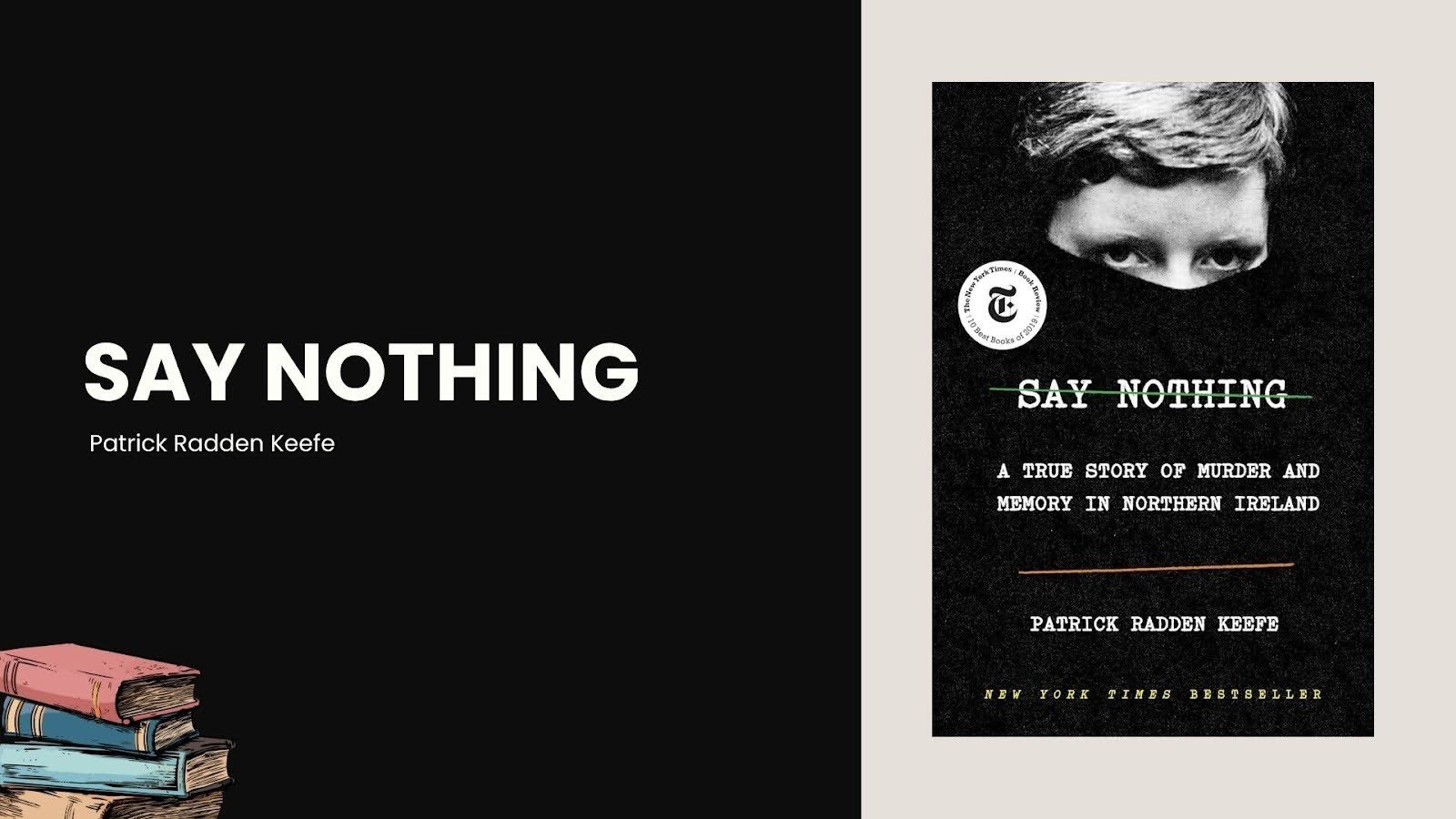
I picked up Say Nothing by Patrick Radden Keefe thinking I’d read just a few pages. Three hours later, I was still glued to it.
This book tells the true story of Jean McConville, a mother who vanished during Northern Ireland’s Troubles in 1972.
Everyone I know who’s read this book has the same reaction. They can’t put it down. It mixes true crime with history in a way that feels raw and honest.
In this review, I’ll share what makes Say Nothing worth your time and why it still matters today.
Let me tell you what I found.
What Does Say Nothing About?
Say Nothing centers on a crime that haunted Northern Ireland for decades. In 1972, Jean McConville disappeared from her Belfast home.
She was a 38-year-old widow and mother of ten children. Masked members of the IRA dragged her away one night. Her kids never saw her again.
Patrick Radden Keefe uses this case to tell a bigger story. The book takes you through the Troubles, a violent conflict that tore Northern Ireland apart for thirty years.
Catholics and Protestants fought. The IRA wanted a united Ireland. British forces and loyalist groups pushed back. Thousands died.
Keefe introduces us to real people who lived through this. Dolours Price was a young IRA volunteer. Brendan Hughes was a commander who made hard choices. Gerry Adams became a political leader who denied his IRA past.
These weren’t fictional characters. They were real people whose actions shaped history. The book shows how they justified violence, kept secrets, and lived with what they did. It’s about loyalty, betrayal, and the cost of silence.
Writing Style & Narrative Structure
Patrick Radden Keefe writes like a detective and a storyteller combined. He spent years researching court documents, secret interviews, and witness accounts. But he doesn’t dump facts on you. He builds scenes that put you right there in Belfast.
The pacing keeps you hooked. Keefe moves between the 1970s and 2000s smoothly, weaving multiple storylines together. The sentences are clear and direct. He explains complex history without talking down to you.
I finished this 400-page book in two sittings. That’s rare. The writing pulls you forward, even when the truth hurts.
Themes Explored
Say Nothing examines the hard truths about conflict, morality, and memory that make this story so compelling and difficult to forget.
Political Violence & Its Legacy
Keefe shows how violence became normal during the Troubles. Young people joined the IRA believing they were freedom fighters. They planted bombs and killed soldiers.
But the fighting’s end didn’t erase the pain. Families still search for buried loved ones. Former fighters struggle with guilt. Communities remain divided. Children who grew up during the conflict still carry those scars.
The legacy lives on in ways big and small.
Moral & Ethical Complexity
This book refuses easy answers. Keefe presents people as they really were, not as heroes or villains. Dolours Price believed she fought for justice. She also helped make people disappear forever.
The British government committed terrible acts too. Soldiers killed civilians. Both sides claimed necessity.
Keefe makes you ask hard questions. When does resistance become terrorism? Can violence be justified? There are no simple answers here.
Memory, Trauma, and Silence
The title refers to a code of silence that ruled Northern Ireland. People saw crimes but didn’t talk. Speaking out could get you killed.
This silence created its own pain. Jean McConville’s children couldn’t grieve or get justice. Some stayed quiet from fear. Others from loyalty.
The book asks whether it’s better to remember or forget. You can’t heal what you won’t face.
Character & Real-Life Figures Analysis
The strength of Say Nothing lies in how Keefe brings real people to life with honesty and depth.
Dolours Price
Keefe shows Dolours as passionate and committed. She joined the IRA as a teenager and carried out London bombings. She believed deeply in Irish freedom.
Later, she became disillusioned. She struggled with guilt and alcoholism. Before dying, she broke the silence and talked about what she knew.
Jean McConville
Jean was a widow raising ten children alone. The IRA accused her of being an informer. The evidence was thin. They took her anyway.
Keefe treats her with dignity. She represents ordinary people caught in the violence.
Gerry Adams
Adams became a political leader and helped negotiate peace. He denied IRA membership.
But Keefe presents evidence placing him in IRA operations. Former comrades say he ordered disappearances. Keefe lays out facts without accusations. He lets readers decide.
Strengths of the Book
Keefe’s research is exceptional. He spent years tracking down sources, conducting interviews, and reviewing classified documents. The level of detail shows his commitment to getting the story right.
The emotional impact hits hard. You feel the weight of loss, guilt, and silence on every page. It’s not just history. It’s human.
Keefe maintains a balanced perspective throughout. He doesn’t pick sides or simplify complex issues. He presents multiple viewpoints and lets the facts speak for themselves.
Goodreads & Amazon Ratings
Say Nothing holds strong ratings across platforms. On Goodreads, it has 4.3 out of 5 stars from over 200,000 ratings. Amazon shows 4.6 out of 5 from thousands of reviews.
Common reader feedback is consistent. People say they couldn’t put it down. They appreciate how Keefe explains complex history clearly. Many call it one of the best nonfiction books they’ve read.
Some found certain sections slow. But overwhelmingly, readers recommend it.
Who Should Read Say Nothing?
This book is perfect for true crime fans who want depth beyond shocking details. History readers will find the Troubles account informative and accessible. Political science students and anyone interested in conflict resolution should read this.
Some might find it challenging. The violence is real and graphic. There are many names to track. If you prefer lighter reads, this might feel heavy.
The book appeals to multiple audiences. True crime readers get a mystery. History fans get context. Political readers get analysis of power.
FX and Hulu adapted Say Nothing into a limited series in 2024. The show brought Keefe’s work to screen and sparked new conversations about the Troubles.
If you’re curious about how violence shapes societies, this book is for you.
About the Author

Patrick Radden Keefe is an award-winning journalist and staff writer at The New Yorker. He’s known for investigating complex stories that others avoid.
Keefe’s approach is thorough and patient. For Say Nothing, he spent years conducting interviews and reviewing archives. He builds his case piece by piece.
His other notable books include Empire of Pain about the Sackler family and the opioid crisis. It won the Baillie Gifford Prize. The Snakehead examines human smuggling. Both show his skill at turning investigations into gripping narratives.
Keefe has won the National Magazine Award and the Orwell Prize. What sets him apart is his empathy. He writes about everyone with humanity.
Conclusion
Say Nothing is one of the most powerful nonfiction books I’ve read.
Keefe tells a difficult story with honesty and skill. He doesn’t simplify the Troubles or offer easy answers. He shows you the real cost of violence and silence.
I give this book 5 out of 5 stars. It’s not easy, but it’s important. The writing kept me hooked throughout.
I highly recommend Say Nothing. Read it to understand how conflict shapes lives. Read it for brilliant investigative journalism. Just be ready for a story that stays with you.
Frequently Asked Questions
Is Say Nothing based on a true story?
Yes, Say Nothing is completely true. Patrick Radden Keefe based the book on real events, interviews, and historical records from Northern Ireland’s Troubles.
How long does it take to read Say Nothing?
The book is about 400 pages long. Most readers finish it in 5-7 days, though many report reading it faster because it’s so gripping.
Is Say Nothing appropriate for young readers?
The book contains graphic descriptions of violence and mature themes. It’s best suited for adult readers or mature teens with an interest in history.
Do I need to know about Irish history to understand Say Nothing?
No prior knowledge is needed. Keefe explains the historical context clearly throughout the book, making it accessible to all readers.
Is the Say Nothing TV series faithful to the book?
The FX/Hulu series follows the book’s main storylines and themes closely. Some details are condensed for television, but it captures the book’s spirit well.