
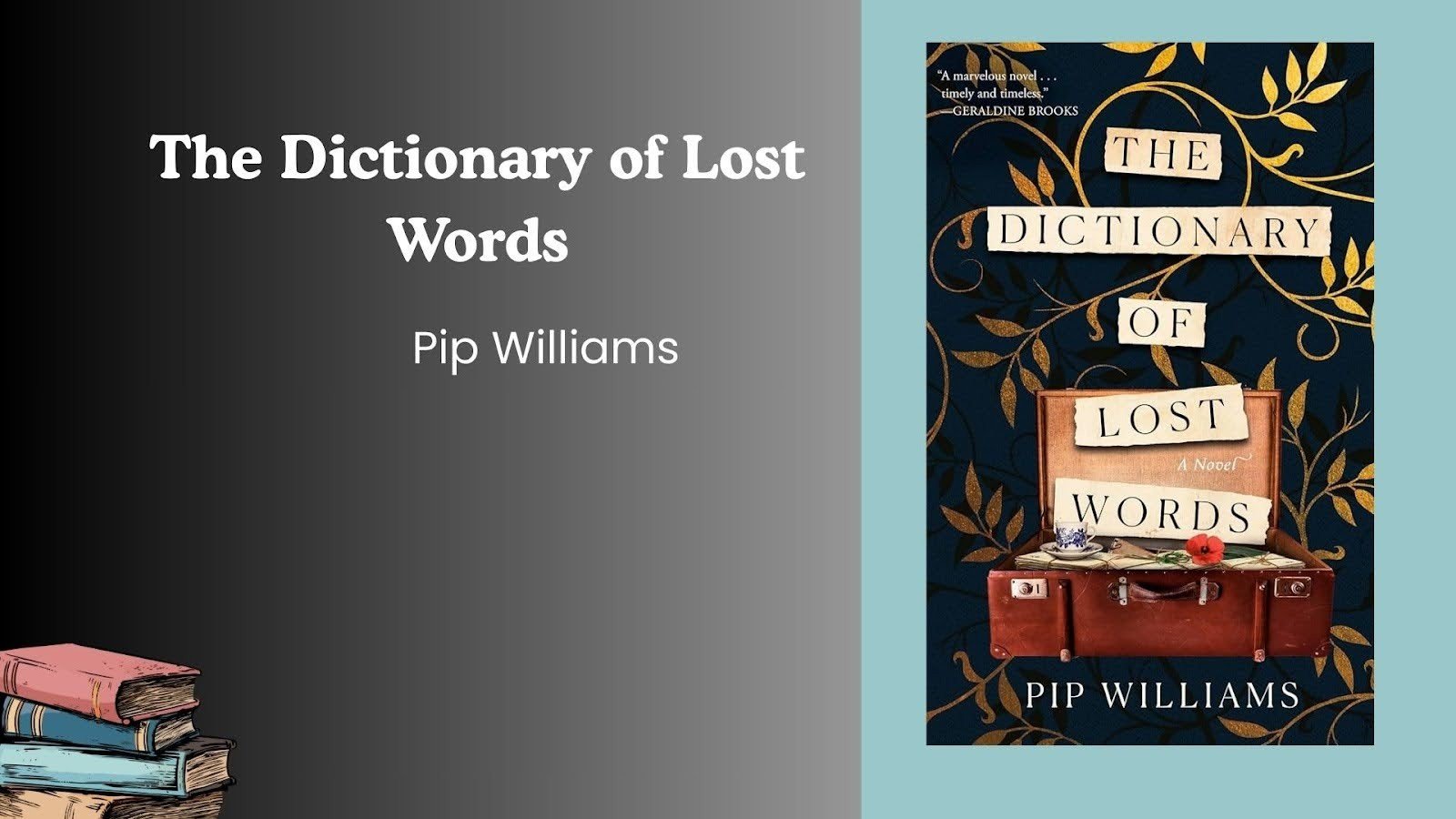
You searched for the dictionary of lost words summary? Don’t worry – I’ll give you everything you need in one place.
I’ll break down the complete plot, central ideas, and some of the reader’s thoughts about this book. No extras, just useful information.
Here is why you can trust this summarized details: I have viewed many reviews and monitored readers’ reviews/read the book, so you can expect accuracy. I want to help you determine if this book appeals to your reading style.
In this brief article, I will provide the author, a plot summary of the book, major themes, a critical review, quotes of interest, reader ratings, and the reason to read it.
What Makes This Book Special

This isn’t just another historical novel. It’s a story about language and power.
Pip Williams takes us inside the creation of the Oxford English Dictionary. But she focuses on what got left out.
The book asks a simple question: Who decides which words matter? The answer reveals a lot about gender and class in history.
Readers call it eye-opening. It changes how you think about language itself. You’ll finish this book noticing gaps in the stories we tell.
Plot Summary

Follow Esme Nicoll’s life in the Scriptorium during WWI as she collects words ignored by male lexicographers.
Setting and Time Period
The story takes place in England during World War I. This was also the time of the women’s suffrage movement.
Most scenes happen in the Scriptorium. This is the place where scholars compiled the Oxford English Dictionary.
The book spans several decades. You see how language and society change over time.
Main Characters
Esme Nicoll is the main character. She grows up in the Scriptorium where her father works on the dictionary.
Ditte is Esme’s maid and mother figure. She teaches Esme about words not found in books.
Lizzie is a suffragette who influences Esme’s views. Edith Thompson works on the dictionary and becomes important to Esme.
Key Storyline
Young Esme finds a slip of paper under a desk. The word “bondmaid” is written on it. This word never makes it into the dictionary.
She realizes many words are being left out. Especially words used by women and working-class people.
Esme starts collecting these lost words. She creates her own dictionary of forgotten languages.
The story explores memory and how words shape our understanding of history. It asks who gets to decide which words matter.
Themes and Insights

Gender bias in language, the power words hold, and historical context shape this thought-provoking narrative beautifully.
Gender and Social Bias
The Oxford English Dictionary was created mostly by men. The entries reflect male perspectives.
Words about women’s daily lives got ignored. Terms for female experiences were often excluded.
The book shows how language can erase certain groups. If your words aren’t in the dictionary, your experiences don’t seem valid.
Power of Language
Words preserve memory. They keep experiences alive across generations.
The book argues that language reflects how we live. When we lose words, we lose parts of our history.
Esme’s collection becomes a form of resistance. She’s saving the voices that others tried to silence.
Historical Context
The story happens during major social changes. Women fought for the right to vote.
World War I changed everything. Class divisions were strong in England at this time.
Williams mixes real historical figures with fictional ones. Some events actually happened. Others are imagined to fill gaps in the historical record.
Critical Reception
Readers praise the historical research and feminist angle, though some note pacing issues and character development limits.
Public Reviews
Most readers give the book 4 out of 5 stars. They appreciate the thoughtful storytelling.
The historical accuracy impresses many reviewers. Williams clearly did her homework. The themes resonate with readers. People love learning about hidden histories.
Some criticism exists too. A few readers find the plot moves too quickly. Decades pass in just a few chapters.
Some characters feel underdeveloped. The compressed timeline doesn’t allow deep relationships to form on the page.
Expert & Media Reviews
Literary critics highlight the extensive historical research. Williams spent years preparing to write this book.
The feminist perspective gets strong praise. The book asks important questions about whose voices matter.
Critics appreciate the focus on language itself. The book makes you think about words in new ways.
Memorable Quotes

Powerful lines about language, memory, and resurrection show the book’s central message about preserving forgotten voices.
“Words are our tools of resurrection.” This quote captures the book’s heart. Words bring the past back to life.
“Few words have as many variants as love…” This line reminds us that language is complex and personal.
The book is full of reflections on how we use language. Each quote makes you think about the words you take for granted.
These passages show why language matters. They explain how words carry meaning beyond their definitions.
Why You Should Read It
Perfect for history buffs and word lovers who want entertainment mixed with important insights about language exclusion.
If you love historical fiction, this book delivers. It brings a specific time and place to life.
Linguistics fans will appreciate the focus on how dictionaries get made. You’ll never look at reference books the same way.
The feminist narrative adds depth. It’s not just about words. It’s about whose stories get told.
You’ll learn things while being entertained. The book balances education with engaging storytelling.
It opens your eyes to hidden histories. You’ll start noticing what’s missing from official records.
Goodgrades & Ratings
Most readers rate it 3.5 to 4.5 stars, praising research and themes while noting timeline compression issues.
On Goodreads, the book has an average rating of 4.01 out of 5 stars with over 186,000 ratings. This shows strong reader approval across a large audience.
Average reader ratings on other review sites sit around 4 out of 5 stars. Review platforms show consistent praise.
Pros readers highlight:
Strong historical research gives the book credibility. The feminist perspective feels fresh and important. The storytelling keeps you engaged throughout.
Cons readers mention:
The compressed timeline can feel rushed. Some decades pass too quickly. The plot-driven structure means less time for character depth. A few supporting characters could use more development.
Overall, most readers recommend the book despite minor issues.
Is There a Series or Movie?
Good news for fans of the book. The Dictionary of Lost Words is being adapted as a TV series by Australian production companies Highview Productions and Closer Productions. The rights were acquired in 2022.
Pip Williams will serve as executive producer alongside Alex Dimos and Andrew Nunn. The production companies previously worked together on the drama series The Hunting.
The TV series is still in development. No release date has been announced yet. Fans are waiting to see Esme’s story brought to screen.
Additionally, a stage adaptation premiered in Adelaide in September 2023, then showed at the Sydney Opera House in October 2023. The play was produced by the State Theatre Company of South Australia and Sydney Theatre Company.
About Pip Williams

Pip Williams is an Australian author who made her debut with this book. She worked as a social researcher before becoming a novelist.
Her interest in the Oxford English Dictionary led her to years of research in Oxford archives. She read old letters, documents, and dictionary slips to understand the real history.
Williams holds a PhD in creative writing. She lives in Adelaide, Australia. The book took nearly a decade to complete because she wanted to balance historical accuracy with good storytelling.
What sets her apart is her focus on ordinary people and voices that got ignored. The book has been translated into multiple languages and resonates with readers worldwide.
Conclusion
I hope you now understand why the dictionary of lost words summary is significant. It made me reconsider the words we use in our daily lives and the people we pick to remember in history.
Reading about Esme’s story reminded me how important it is to recognize the power of language and the voices we want to preserve.
Let me know if you read this book or are thinking of reading it. I would love to hear your opinions. Feel free to leave a comment below and let me know your thoughts about words we left behind.
Let’s continue the conversation.
Frequently Asked Questions
What is The Dictionary of Lost Words about?
The book follows Esme Nicoll, who grows up in the Scriptorium where the Oxford English Dictionary was created. She collects words that male scholars excluded, especially those related to women’s experiences.
Is The Dictionary of Lost Words based on a true story?
It’s historical fiction based on real events. The Oxford English Dictionary’s creation is real, but Esme and her personal story are fictional creations by Pip Williams.
What are the main themes in the book?
The book explores gender bias in language and the power of words to preserve memory. It examines who decides which words and experiences matter enough to preserve in history.
Who should read this book?
Readers who enjoy historical fiction, linguistics, or feminist narratives will appreciate it. If you’re curious about language history or overlooked historical figures, this book is for you.
How accurate is the historical research?
Pip Williams spent years researching in Oxford archives for this novel. Critics praise the accuracy of the historical setting, dictionary creation process, and social context throughout the book.